
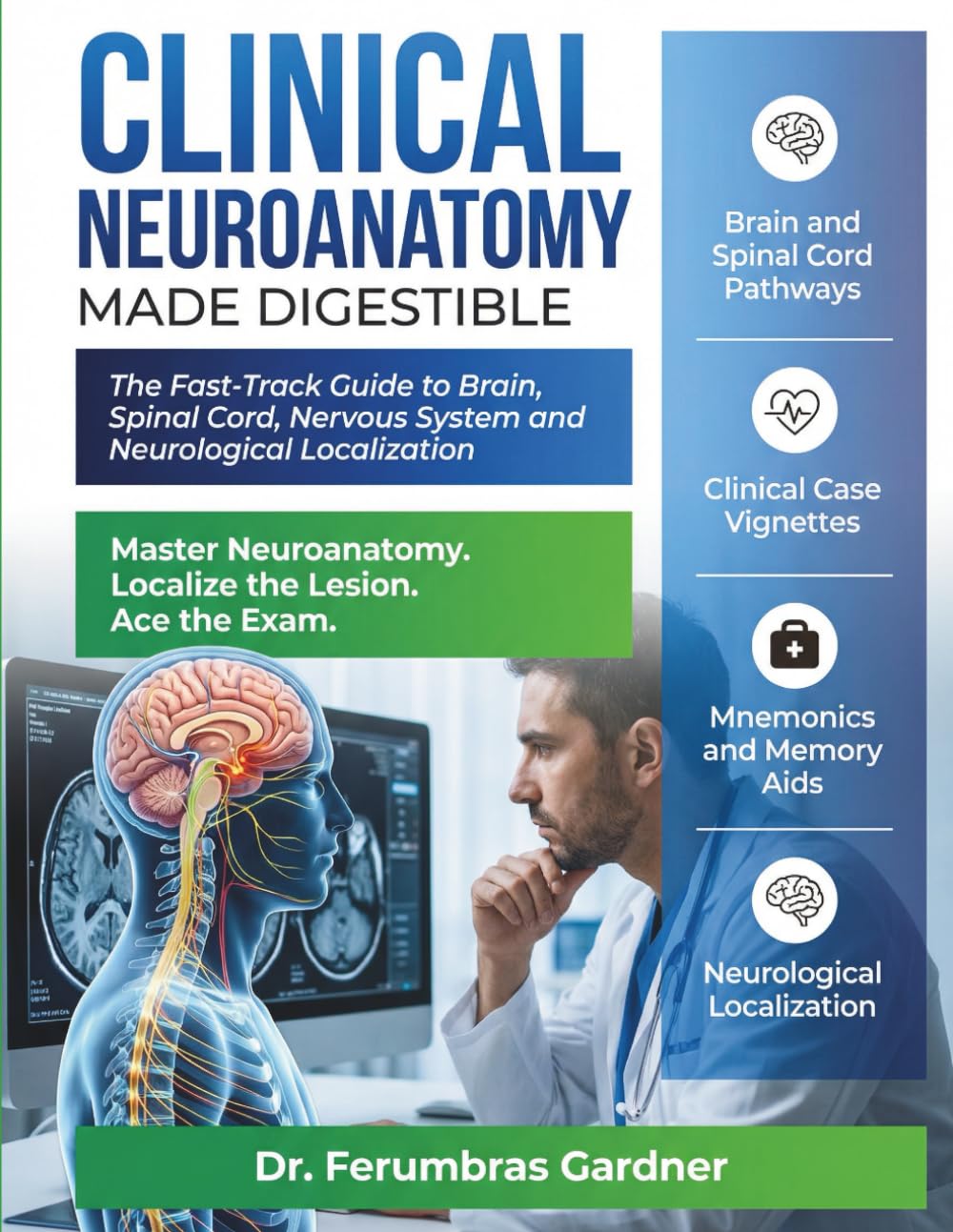
Clinical Neuroanatomy Made Digestible: The Fast-Track Guide to Brain, Spinal Cord, Nervous System & Neurological Localization for Medical Students with Clinical Cases and Mnemonics
Product details
| Management number | 233516050 | Release Date | 2026/06/27 | List Price | US$8.96 | Model Number | 233516050 | ||
|---|---|---|---|---|---|---|---|---|---|
| Category | |||||||||
Clinical Neuroanatomy Made Digestible is a thirteen-chapter neuroanatomy handbook written for medical students, nursing students, allied health professionals, and international medical graduates preparing for licensing examinations including USMLE Steps 1 and 2 and MRCP. Every chapter has its own visuals to help with explanations.The book covers the following topics in sequence:Chapter 1 introduces the organisation of the central and peripheral nervous system, its divisions, and the foundational terminology used throughout clinical neurology.Chapter 2 covers the meninges, the ventricular system, cerebrospinal fluid production and circulation, and the clinical presentations of meningitis, hydrocephalus, and lumbar puncture findings.Chapter 3 addresses the cerebrovascular supply, arterial territories, the Circle of Willis, venous drainage, and the anatomical basis of stroke syndromes.Chapter 4 explains spinal cord organisation, the major ascending sensory and descending motor pathways, dermatomal and myotomal maps, and the incomplete and complete spinal cord syndromes.Chapter 5 covers the three levels of the brainstem, cranial nerve nuclei and their functions, and the named brainstem syndromes including Wallenberg, Weber, Benedikt, and Foville.Chapter 6 traces the visual pathway from the retina to the primary visual cortex, the pupillary light reflex pathway, the control of eye movements, and the clinical visual field defects produced by lesions at each level.Chapter 7 explains the autonomic nervous system, the sympathetic and parasympathetic divisions, the hypothalamus as the central autonomic regulator, and the clinical presentations of Horner syndrome and dysautonomia.Chapter 8 covers cerebellar anatomy and function, the basal ganglia circuits, the thalamus as a relay hub, and the clinical presentations of ataxia, Parkinson disease, and tremor.Chapter 9 addresses the cerebral cortex, the functional organisation of the four lobes, the language areas and their clinical testing, memory circuits, and the presentations of aphasia, hemispatial neglect, and dementia syndromes.Chapter 10 applies the anatomical knowledge from the preceding chapters directly to the bedside neurological examination, with a systematic approach to lesion localisation using clinical findings alone.Chapter 11 covers the principal neurotransmitter systems, their receptor pharmacology, and the anatomical basis of drugs used in Parkinson disease, depression, schizophrenia, myasthenia gravis, and epilepsy.Chapter 12 presents ten integrated clinical vignettes, each requiring full lesion localisation with detailed anatomical explanations of the answers.Chapter 13 provides a neuroimaging orientation guide with annotated brain sections on CT and MRI, and a series of spot-the-lesion exercises.A full glossary of neuroanatomical, physiological, clinical, and radiological terms is included at the end of the book.Format and FeaturesEach chapter opens with learning objectives and closes with a summary of high-yield examination points and a clinical case vignette. Mnemonics are provided where they support retention of pathway anatomy and clinical localization rules. Read more
| ASIN | B0GQLPW651 |
|---|---|
| ISBN13 | 979-8250080019 |
| Language | English |
| Publisher | Independently published |
| Dimensions | 8.5 x 0.6 x 11 inches |
| Item Weight | 1.69 pounds |
| Print length | 263 pages |
| Publication date | February 27, 2026 |
Bestseller ranking
Neuroscience


Customers who viewed this product also viewed
Classic Rock


Correction of product information
If you notice any omissions or errors in the product information on this page, please use the correction request form below.
Correction Request Form